![]() | ![]() |
|
In Lund, the city of ideas, you will create your future together with others. In Lund there is an interaction between knowledge, ideas and development. Here you will find the multitude and the new life styles; and the possitbility of a life filled with health, comfort and freedom. Lund, the city of ideas, is also characterized by great openness to new impressions and a good self-esteem combined with humour. Inside the municipality of Lund, not too far from the city, you will find Dalby, Södra Sandby, Veberöd och Genarp in an environment of great natural beauty. The municipality of Lund is a large agricultural region, with arable land to be found in the areas just outside of Lund. You are able to read a lot more about Lund by using the links below:
Want to read more about the city of Lund? - Click here
The largest Nordic Cathedral Lund´s cathedral is the largest and the most beautiful example of the roman architecture in the Nordic countries. Every year the Cathedral, open every day, has more than half a million visitors. Worship services have been held for over 850 years. When the bishop of Lund was elevated into archbishop of the Nordic countries, the work on the church that would become the Cathedral of Lund was intensified. Stone masons from the area around Rhen and from Italy were in charge of creating this mighty cathedral. The main altar in the crypt was consecrated in 1123 by Ascer, the first archbishop of Lund and in 1145; his successor Eskil consecrated the main cathedral building. Large sections of the cathedral were destroyed in a big fire in year 1234 and after this the vault in the central section was rebuilt. Traces from Adam van Düren During the 16th century the Cathedral was restored by the west-phalian stone mason, Adam van Düren, and his sculptured figures can be seen in several parts of the building, for instance in the large and well-preserved crypt. Here you can find a wall that has four sides carved by Master Adam in 1513-1514 and the sarkofag of the last archbishop, Birger Gunnarssen, carved in 1512. In the crypt one can also find two legendary figures made of stone. According to the saying, one of these is the builder of the church, named Finn, the giant. A more likely explanation is that the figure is representing Simon from the Bible. Extensive renovations During the 19th century, the Cathedral was renovated thoroughly, first by CG Brunius and then by Helgo Zettervall. The last renovation (1954-1964) was led by Eiler Gäaebe. Among the movable property, the two bronze statues from the 13th century are the oldest. A big candle stick from the late 15th century is located in the southern part of the cathedral. The finely carved oak choir stalls are from the middle of the 14th century; and the majestic altar dates from 1398. The choir stalls are in use still to this day. The return of Jesus Christ is the theme of the fine Absidens mosaic, made in the 1920´s by Joakim Skovgaard. "Horologium mirabil Lundense" Among the many attractions of the Cathedral, there is the magnificent horological artistic masterpiece, Horologium mirabil Lundense, dating from 1424. This early time and dating machine is still in working order with it rotating mechanical figures marking the passage of time. As I dulci jubilo is played, the three wise men enters and honours baby Jesus in the arms of Maria. The dating machine will show the different phases of the moon and where on the horizon the sun will rise and fall. One will also be able to tell on what day of the week a certain date will occur. For more information about Lund Cathedral - Click here
Time flies In 1970, the city of Lund celebrated 950th anniversary, but already 20 years later it was time for the 1000th year anniversary. The reason for this was that after having made excavations near Kattesund, it was made possible to specify the founding of Lund to the year of 990, when Sven Tveskägg ruled. His son, Knut The Great, founded a mint in winter of 1019-1020. In that way the importance of the city could be secured. Archbishopric in year 1103/1104 The most important event in the early history of Lund was that the city was elevated to become the archbishopric of the Nordic countries in 1103/1104. There is a far distance between Sweden and Italy. The pope of Rom, Paschalis II elevated Lund to a Nordic archbishopric after pressure from king Erik Ejegod in 1103. But the first archbishop Asker did not receive the message from the holy pope until in 1104. Even in 1060 an english kaplan from the court founded by Knut den Store, had become the first archbishop of the Archbishopric of Lund, but Lund had been controlled by the of Archbishopric Hamburg-Bremen. 27 churches and monastries During the Middle Ages, Lund was a church centre. The town was the spiritual capital of Denmark and was referred to as both Metropolis Daniae and the Nordic Rome. Thanks to a donation from the holy Knut in year1085, the possibility was made to build a cathedral. The gift also led to the founding of a cathedral school. At the same location as a smaller church used to lie, the Cathedral of Lund was built to honor S.t Laurentius. The western section of the church and the crypt was finished in 1123. In 1145, Eskil consecrated the main cathedral building. At the most, Lund had 27 churches(!) in or just outside the city centre. At the time of the big Reformation, all were destroyed except for the cathedral and .Today, Drotten´s church has been dug out and is now a museum. Remains of the lost days of glory Today only a few of the medieval buildings are left intact. Kalendehuset, Krognoshuset, Liberiet, Lundagårdshuset and Stäket can give us an image of what Lund might have been like during this medieval period. In year 1134, the city was expanded with surrounding walls and banks. Stadsparksvallen - Högevall - is today the only remaining part, but one can easily find signs from this period of time when looking on a map of lund: Södra Esplanaden, Östra Vallgatan, Biskopsgatan, Allhelgona Kyrkogata, S:t Laurentiigatan, Clemenstorget, Bangatan. In each one of the four cardinal points there was an entrance - customs check. The names of these areas are still in use: Södertull, Östertull, Norrtull and Västertull. The walls and banks was a way to protect the city from outer threats. When it came to catastrophes occurring within the city wall, there was no protection. Violent fires rages over and over again in the following years: 1172, 1234, 1263 and 1287. Even in the 14th century, Skåne had for at short period of time been controlled by the Swedish king. But not much time passed before Skåne was back in the hands of the Danish kingdom. In 1360 king Valdemar Atterdag once again conquered Skåne. He celebrated his victory by spending Christmas in Lund. The Swedes made new attempts to conquer Skåne. Lund was fiercely attacked in year 1452 by the army of Karl Knutsson and a large part of the city was set on fire. The cathedral was rebuilt and just in the beginning of the 16th century the work of embellishing the Cathedral started. In 1505-1527 Adam van Duren rebuilt the Cathedral and also added another level to the towers. He was a great artist, who also embellished the church with art portraying human beings and animals. In 1525 there was another battle of Lund. In Denmark there was a war going on that was named Grevefejden ( "the feud of the counts"). The Scanian farmers supported Christian II, whom they wanted to come back into power. The church looses its power and Lund becomes a small town Because of the Reformation, Lund's era as the centre of power is over. As the church lost the power struggle with the government, Lund also lost its unique position. In 1536, Christian III had archbishop Torben Bille imprisoned, and this crushed the power of the church completely. All the Danish bishops were dismissed and replaced by evangelical superintendents. In 1537 Frans Vormorden became superintendent. In 1550 Christian III ordered to demolish all the churches in Lund. The Cathedral and Klosterkyrkan were the only ones left untouched. Royal gift became the foundation of the hospital In 1578-84, Fredrik II had a house built close to the Cathedral. The house remains still today at the same location in Lundagård; it's called Kungshuset or Lundagårdshuset. The same king, Fredrik II, donated in 1567 some land, located in the south of Lund, to the cantor of the Cathedral. The profits were donated to the poor. In 1756 the decision was made to let the profits go to the building of a hospital. At the start, the hospital was very small and could offer not more than two beds for patients. The first pharmacy in Lund, later to be called "Svanen" was founded by Esaias Sleishcher in 1627. The pharmacy is still located at the same spot, but in a newly build house. War, war, war and university In 1644 the Swedish army had its headquarters in Lund, and was therefore laid waste by the Danes. However, the Danes were not successful and during the peace agreement in Roskilde in 1658 they lost Skåne to the Swedes. As a step in the process of making Skåne and the other landscapes Swedish, the decision was made to found a university in Lund. Bishop Peder Winstrup had the first academic printer of Lund, Vitus Haberegger, to print the preacher he had held in the Cathedral of Lund at the opening of the university. The new university also appointed an academic bookseller - Adam Junghans. Despite the peace that had been made in 1658, the hostilities were far from over. The Swedish king Karl XI had to struggle to protect his newly conquered province. In a snowstorm and with great losses from both sides, the Battle of Lund was fought in 1676. The Swedish army was led by field marshal Simon Carl von Arensdorf. After the battle, bishop Peder Winstrup invited the victor for dinner. He would have preferred to have Christian V as guest of honour. The war was lasted a long time and the city was set on fire by the Danes in 1678. Out of the 304 houses in Lund, 163 were burned to the ground. The year after, peace was finally made. On the night of the 26th of September 1670 the peace treaty was signed, probably in Kalendehuset, a house that still remains today. Lund´s position in the new kingdom was not lower than it had been in Denmark. The Cathedral kept its property and in 1681 the decision was made for Lund to continue as a Archbishopric in the future. The country is ruled from Lund Lund had lost power, importance and welfare trough the war and the Reformation, and was in the beginning of the 18th century struck by further difficulties. Swedish and Danish troops alternated to be placed in the city. Fires raged in the years 1703 and 1711, and the bubonic plague claimed numerous victims in 1712-1713. This city, which had gone through a number of trials, was for a short period of time the place where the Swedish king would reside. From September 6th 1716 until June 11th 1718, Karl XII lived in professor Hegardt´s house at Södergatan. Today this house is a part of Katedralskolan, an upper secondary school. The king´s escorts - around 500 of them - needed lodging. Many of the 1100 citizens of Lund had to make their homes available for the "guests". Highly dangerous to fail the examination Even the students had a hard time. The army was constantly in the need of new soldiers. The Swedish king announced that lazy students would be commanded by force to join the army. The professors planned interrogations with all students, but this action from the king provoked such fury among the students that their demonstrations led to a cancellation of the exams. Linné and Hårleman Carl von Linné is probably most associated to Uppsala University, but in the year of 1727 he studied at Lund University. He stayed with Kilian Stobaeus, just south of the Cathedral. In remembrance of his time in Lund, a statue of him was erected at Petri-platsen. Statues were also erected in 1853 representing Esaias Tegnér and in 2003 in remembrance of Henric Schartau Carl Hårleman. Hårleman is mostly known as the architect from Stockholm who was assigned to reshape Lundagård in the 1740:ies. He had a wall put up that was surrounding the park, but the last part of it was torn down by students during the riots in year 1842. One of the gates was preserved and is now part of the magnificent entrance to Kulturen. Borg and Berling During the 18th century some companies were founded that later would turn out to grow larger. In year 1734 Hans Borg started a paint shop. The family firm was bloom-ing for generations and the Borg family and their firm was an important part of the expansion of Lund. The firm kept running until the 1960ies. Another old company is the Berling book printing firm. Carl Gustaf Berling took over an older book printing house and became an academic book printer in year 1746. The company was bought by a book printer named Håkan Ohlsson in year 1943. Silk in Lund A business that was blooming only for a short period of time was Eric Gustaf Lidbeck´s attempts to make silk. In the middle of the 18th century the professor planted mulberry trees and grew silkworms. Harsh winters unfortunately got the mulberry trees blighted by frost. Newspapers The Berling book printing firm started distributing Lunds Weckoblad ( "Lund's weekly paper") in 1775 and until the 1970ies the citizens of Lund has had access to their own newspaper. But Lunds Weckoblad was not the first paper of Lund. Even at the time when Karl XII was residing in Lund (1716-1718) there was a newspaper - Lundska lögerdags courant. A new era starts on October 4th 1799 On the 4th of October 1799 Esaias Tegnér was registered at Lund University. He called the city "an academic farming village", and was in some ways right by doing so. In the beginning of the 20th century one would still be able to buy milk straight from the barn even in the middle of the city. In year 1824 he left the city to become the bishop of Växjö. Tegnér had revived the academic Lund, but Lund was also blooming in other ways during the 19th century. The number of inhabitants increased, companies were founded, houses were built and squares were made. The hospital was growing and the number of students as well, which was the cause for the expanding of the university. In 1830 Akademiska Föreningen ("Academic Association") was formed and in 1851 they had their own building - Ynglingaborgen. Otto Lindblad founded the Student's singer association of Lund in 1831 and enriched their repertoire with lots of his works. The Cathedral is restored and Allhelgonakyrkan is built C.G. Brunuis, professor in Greek language, led the restoration of the Cathedral in 1836-1859. In 1860 Helgo Zetterwall was appointed architect of the Cathedral and continued the rebuilding until 1880. The church has since then been restored but never as thoroughly as when Zetterwall did it. From the outside it still looks like it did at the end of the 19th century. At this time the Cathedral didn't have enough capacity to handle the growing number of citizens of Lund. Therefore a larger church was established at the northern part of Lund - Allhelgonakyrkan, designed by Helgo Zetterwall. Technical progress The technical progress could be noticed in Lund. On December 6th 1856 the railroad was opened for traffic between Malmö and Lund. The Central Station building was completed in 1859 and the first trains called Pågatågen started moving in 1983. The gasworks, which gave Lund its street lights, was built in 1863. After precisely 100 years it was shut down. The first phone catalogue arrived in 1884; the sewer system was extended during the 1890ies; the city had its own electricity board in 1905; its first bus line in 1927, and the construction sewage treatment works at Höje Å started in 1933. In the summer of 1907 there was a large exhibition of industry, handicrafts and arts in the area that in 1909-1911 was made into the City Park. Culture is flowing in Lund Kulturhistoriska föreningen (Cultural History Association) of southern Sweden, also called Kulturen, was founded in 1882 and the initiator Georg J:son Karling was made curator. Far later in the year of 1957, there is the opening of Lunds konsthall (Lund's art gallery), designed by Klas Anshelm. August Strindberg spent some years in Lund at the end of the 19th century. He moved around a lot and lived on Skomakaregatan, Tomegapsgatan and Grönegatan (in the house opposite of the Hotel Concordia building), among other streets. He celebrated his 50th birthday in Lund in his editor Waldemar Bülow´s house at the corner of Mårtenstorget and Östra Mårtensgatan. The city expands and the welfare is increased The old and the poor were favoured; in 1907 they could leave their home on Själbodgatan and move in to the newly built Mårtenslund. Lund incorporates land outside of the city walls. In 1913 the city expands to the south by including a part of Lilla Råby. The city expands to the west as the parish of S:t Peter´s monastery is incorporated in 1914; Stora Råby and Torn in 1952; Södra Sandby ,Dalby, Veberöd and Genarp in 1974. New parts of the city is created; Klostergården in 1963; Norra Fäladen in 1967; Linero in 1969; Norra Nöbbelöv in 1973; Gunnesbo in 1980 and Värpinge in the 1990ies. In 1938 the packaging company Åkerlund & Rausing moves to Lund. Tetra Pak is established in 1952. Director Hogler Crafoord founded Gambro in 1966, to start manufacturing the artificial kidney that was constructed by Professor Nils Alwall. The political development The first election with universal suffrage was held in 1919. From this year until 1954 the social democrats had the majority of voters of Lund. The non-socialist parties together form majority during 1954-1988. Ever since then the majority has altered. The issue that engaged the citizens of Lund the most during the late 20th century was "the breakthrough". The plans to construct a highway, that would lead from east to west in the southern part of Lund, were on the verge of being fulfilled but were abandoned in year 1969. Lund is expanding The general hospital of Lund started with beds for two patients in 1756. When the central building of the hospital was completed in 1968, it had the capacity of holding 1666 patients. The concept "City of Lund" was in 1971 replaced with "Municipality of Lund". The same year a part of the city centre closed for traffic. However, bicycles were allowed to pass. Lund is still expanding and today the number of inhabitants has passed over 100 000.
The University of Lund has its place among the leading universities in Europe. The university is the largest unit for higher education and research in Scandinavia today. Around 6000 teachers, researchers, administrators and technicians work together within a wide range of matters. The number of students are approximately 41 000 (equivalent to 27 150 full time students) The majority of the University is located in Lund, but there are also several academic and research institutes in Malmö. The University also has a campus in Helsingborg and learning centres in several towns in Skåne. Lund University also has the largest Internet based education in the country. At the University of Lund the education always stays in close contact with the research and society. Education of all levels aim to develop the qualities that are characteristic for a university; analytical skills, critical thinking and the ability to search for, gather and present information. The contents in and range of the different courses are continuously changing to meet the demands for a good and relevant education. The University of Lund has a close cooperation with a number of universities all over the world. The international academic environment together with a vital culture and communities in the Öresunds-region leads to innovative and border crossing project that our students and researchers may benefit from. The University of Lund protects the free research and its importance to the development of society. The University also carries on an extensive applied research in a close cooperation with the private and public sector. The University contributes to the creation of new businesses, with the university research as a starting point. For more information about the University of Lund - Click here
Museums: Kulturen Kulturen is like and oasis in the very centre of Lund. The museum, founded in 1882, spreads out across two city blocks. Inside the museum walls you are transferred from the hustle and bustle of the city to a peaceful and quiet environment. Here you are able to do your own journey through time and space. Kulturen has about thirty houses and buildings, surrounded by peaceful surroundings. The museum has an extensive exhibition activity. The exhibition area itself is approximately 11 000 square metres. Here you will find a mixture of permanent exhibitions and temporary guest appearances. There are base exhibitions on design, university history and the Middle Ages but also ethical issues and popular culture. At Kulturen is also a playground and creative workshops on different themes for children and young people. Kulturen has roughly 100.000 visitors per year, and is owned by an association called Kulturhistoriska föreningen för södra Sverige ("Southern Sweden's Cultural History Association) For more information about Kulturen - Click here
Lunds Konsthall Lunds Konsthall is the result of a donation from "Gamla Sparbanken" (now "Sparbanken Finn") to the city of Lund. In 1953 the City Council decided to accept the gift from the foundation. The very same year, six architects were invited to take part in a contest for the design of Lund Konsthall. In 1954 the Prize Committee gave its unanimous opinion; Klas Anshelm's project was the right one for Lund. On the 1st of September 1957, Lund Konsthall was inaugurated featuring the exhibition "Swedish Art of Today" with fifteen painters and seven sculptors participating.The well-known architect, Klas Anshelm (1914-1980), created a building with light and space, with alternating high and low rooms, open balconies and semidefined galleries. There is a lot of open space for larger projects, but there are also intimate rooms for subtle distinctions. One space leads naturally to another in an "architectural walk", where the architecture and the expressions of art form a unity. Klas Anshelm was very fastidious when it came to making comments about his own architecture and when he did, it was in terms of function, utility, economy etc. This doesn't mean that Lund´s Konsthall doesn't have a story to tell. The certain purposes and aims intended by the architect will merge into the substance and manifests themselves as signs in the physical shape. In spite of the fact that Lund´s Konsthall isn't quite intact as to the architectural expression, the building has escaped any radical reconstruction, but it was thoroughly renovated in 1997 thanks to a contribution from Sparbanken Finn. On the 6th of March 2004, after two month of a requisite renovation, Lund´s konsthall reopened with fresh-looking premises and with a new image included in the exhibition programme. It was once a building for large pictures and sculptures. Lund´s Konsthall of today is a place for interna-tional contemporary art. The temporary exhibitions are enriched with lectures, seminars, artists talk and musical events etc. For more information about Lunds Konsthall - Click here
Skissernas museum Skissernas museum ("Museum of Sketches") is a unique museum of arts, specialized in gathering sketches and models of monumental art in a public environment. The collection is one of the largest of its kind and consists of roughly 25 000 numbers from Sweden, Denmark, Norway, Finland, Iceland, France, Mexico and West Africa, among other countries. The emphasis is made on Swedish artists, but the collections also have world famous names like Matisse, Léger, Robert and Sonia Delaunay, Gleizes, Dubuffet, Orozco, Rivera, Siqueiros and Henry Moore. The museum was founded in 1934 as an archive for research by Ragnar Josephson, professor of history of art at Lund University. The fundamental idea was to gather sketches to illustrate and document the creative process; "the birth of the work of art". In 1941 the archive was inaugurated as a public museum in a former gymnasium on Finngatan, near the Library of Lund´s University. Since then the museum has been extended by stages and is today one of Sweden's largest museum of arts with one of the most extensive collections of 2000th century art in the country. To that adds research archives and libraries. The University of Lund is head of the museum and it has the double role of being both a research institute and a public museum. A generous selection of the collections are exposed in the permanent exhibitions at the museum, which have an informal and studio like character that distinguishes it from other museums of art. Since autumn of the year 2001, Skissernas Museum has been closed in order to complete the largest rebuilding and extension of the 70-year-old history of the museum. Johan Celsing, architect from Stockholm, won the architect competition in 1999. After having evacuated the museum for two years, it has now moved back with the collections and is gradually putting up new base exhibitions in the museum halls. The museum was reopened in March 2005. For more information about Skissernas museum - Click here
Other experiences:
The Botanical Garden The Botanical Gardens (Botan) is one of the three central parks in Lund. It has a large number of visitors and is of importance when it comes to teaching, pedagogical activity and research. The University owns and administrates the whole area. The opening hours are partly limited; the park is surrounded by a fence and is more fragile than ordinary parks. The park is a building memorial and the park´s history started when Tornlyckan was made available to the University in 1815 in order to establish a "Tree school for wild trees". This as a step in a project lasting for 10 years, that was to stimulate farmers to plant more trees. The older botanical garden, that was located next to Lundagård, had to move from its central spot. This land, that now belonged to the University, was used by J.G. Agardh to create a new botanical garden. The Botanical Garden represent the ideal style of a park. The outer edges of the park have a more free form compared to the more strict form in the middle section. This is illustrated in Agardh's plant system; Theoria systematis plantarum. To have the ultimate conditions for different kinds of vegetation, ponds were dug out and the shaft pulp was used to make hills. The garden was expanded in the late 19th century as a new faculty building was constructed in the park called Östra promenaden. The city of Lund donated areas, helping the expansion of The Botanical Garden. In exchange the park always was to be open to the public. The wall surrounding the park in the north and east is eventually older than the garden itself and should be regarded as firm ancient remains. The oldest building from 1867 - Agardhianum - and other buildings such as Orangeriet, Kolhuset and the Botanical Museum contributes to the character and wealth of experience of the Botanical Garden. The park has developed through the decades and is today a very vibrant garden that contains both extensive research and teaching as well as great esthetical and recreational values. The large variation of the environment, the occurrence of water and old trees provides the opportunities for at very rich vegetation and animal life.
Cinemas in Lund
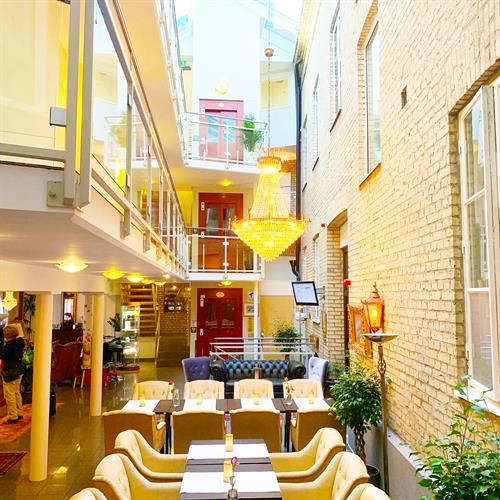
Welcome to the personal Hotel Concordia in the centre of Lund, Sweden!
|